Packing decisions
Packing when your belongings will go into storage

Packing for storage is different from packing for a direct move. A box delivered to the new home may be opened the same week. A box placed in storage may remain closed for an uncertain period, and you may need one item while everything around it is stacked. The plan should account for access, identification, protection, and the specific conditions of the place where your belongings will be kept.
Start with the route of each item. Some belongings will go directly to the new home, some will stay with you, and others will be stored. Label those routes before packing. If storage is temporary while you wait for a new address, record what you will need in the meantime. Packing every room into one undifferentiated shipment can create an expensive and frustrating search later.
This guide addresses ordinary household planning, not the rules of any particular facility or transport service. Read the current storage agreement, ask about prohibited items and access procedures, and follow the instructions for the belongings you own. A facility's description may not answer every question about an individual object. Resolve uncertain cases before loading.
Decide what storage is for
Write down why each group of belongings will enter storage. The reason may be a gap between homes, limited space at the new address, a renovation, or a decision that has not yet been made. These reasons imply different retrieval dates and levels of access. A box needed next month should not be buried behind furniture that may stay for a year.
Separate true storage items from things that should be used, donated, sold, recycled, or disposed of. Storage is not a substitute for deciding whether an unwanted item has a place in your life. If you are uncertain, mark the decision and a date to revisit it. Do not let undecided boxes consume the most accessible space without intention.
Make a list of items you must keep with you while the storage unit is closed or difficult to reach. Documents, clothing, work tools, medication, and other personal necessities belong in a separate plan based on your circumstances. A storage inventory can tell you where something is, but it cannot make a buried box available during an urgent need.
Estimate the likely duration honestly, with room for change. A short gap may become longer because plans shift. The uncertainty should influence what you store and how thoroughly you identify it. Do not claim an exact retrieval date on a box if you do not have one.
Learn the actual facility conditions
Ask the facility or service about access hours, loading arrangements, unit location, and any rules that affect packing. Check whether there are limitations on materials, contents, or the way items may be stacked. Confirm who can enter the space and what identification or codes they will need. Keep the answers with your move records.
Find out what the facility promises about environmental conditions, and read the agreement rather than relying on a general label. A term used in marketing may not describe the exact temperature or humidity an item will experience at all times. If an object has specific storage requirements, compare them with the facility's written information and the item's manufacturer guidance.
Before choosing the unit, make a short list of the most sensitive belongings you intend to store: electronics, photographs, textiles, papers, or furniture finishes, if those categories apply to your household. Look up the care instructions for those actual items. If a material needs conditions the facility cannot confirm, choose another place or a different storage plan for that item. Do not infer that one set of conditions is suitable for everything in a mixed household shipment. A focused list makes your questions to the facility more precise and keeps the packing decision tied to the objects you own.
Inspect the unit or ask for current details if you cannot visit it. Note the clear door opening, internal dimensions, and any features that affect layout. A unit that nominally has enough volume may still be awkward for a long sofa or tall cabinet. Measure large pieces and consider how they will pass through hallways and elevators on the way to the unit.
Check the cost and practical steps of accessing the unit as well as the posted hours. If you expect frequent visits, note whether a vehicle can reach the loading area, whether carts are available under the facility rules, and how far the unit is from the entrance. Those details may change which boxes deserve the easiest positions. If another person will retrieve items for you, learn the authorization process and give that person the box codes and location sketch they actually need. Avoid handing over the entire private inventory when a shorter retrieval list will do.
Ask what happens at retrieval. Will you move the goods yourself, schedule a service, or request delivery? The answer affects how precisely the unit should be organized and whether you can reach a single box. Record any appointment or notice requirements so a future retrieval is not delayed by an assumption.
Create a storage-specific inventory
Give every stored box and large item an identifier. A simple code such as S-01, S-02, and so on works if it is unique. Record the code, broad contents, current condition where useful, and an estimated location in the unit. Keep the detailed list privately, especially when it includes personal or valuable belongings.
Do not rely only on room names. A box marked “kitchen” may contain everyday dishes, holiday serving pieces, or a specialty appliance. Note the useful category on the outside and more detail in the private list. If you may retrieve only one item later, record enough information to identify the correct carton without opening every kitchen box.
Photograph the packed unit from the door and from other safe vantage points as the layout develops. Photograph the label of a box before it disappears behind other items. Photos can help reconstruct the arrangement, but they should supplement the written inventory. A picture of a closed stack may not reveal which box is at the back.
Keep the inventory accessible outside the unit. Save a copy you can reach if a phone is lost or an account becomes unavailable. Share it only with people who have a reason to use it. Update the record when a box is added, removed, or repacked; otherwise it becomes a snapshot of a plan that no longer exists.
Label for a future reader
Use clear, durable labels on more than one visible side of each box. The destination should say storage, not the room in the new home. Include the box code and a broad category. If a box needs special handling, add a concise note that actually changes how it should be placed or carried.
Consider the person who will open the unit six months later. “Miscellaneous” gives little help. “Baking equipment” or “winter linens” is more useful. Avoid placing sensitive details, account information, or exact valuations on the outside. The private inventory can supply specificity without advertising contents.
Choose labels and ink that remain attached and legible on the container you use. Test a sample if the surface is glossy, dusty, or textured. Cover old shipping labels and prior move instructions. A box should present one current identity, not a collection of competing marks.
For a method that connects room destinations, box codes, handling notes, and private contents, see a room-by-room labeling system for moving boxes. Adapt the destination field to “storage” and include the planned retrieval zone when it is known.
Pack for the item, not the empty space
Choose a suitable container for the contents and expected handling. Sound cartons may work for many ordinary belongings; other items may need fitted protection or a different container. Follow product instructions, carrier requirements, and facility rules. Do not use a carton merely because it is available if it is weak, damp, or the wrong shape for the load.
Avoid packing a box so heavily that it cannot be moved safely later. A storage unit may be accessed by someone who was not present for the original packing. Make the load manageable and label it when its weight or orientation deserves attention. Stable packing matters more than filling every cubic inch.
Protect items from contacting one another where that contact could cause damage. Separate fragile objects and keep heavy pieces from crushing light ones. Fill voids appropriately without pressing on delicate parts. Check whether contents shift before sealing the carton. A long storage period makes a weak packing decision difficult to correct later.
Do not place an item in storage before checking whether the facility permits it and whether it can tolerate the stated conditions. Food, liquids, hazardous materials, living things, and other categories may be restricted. The exact list belongs to the facility and applicable rules; use those current sources for the decision.
Prepare furniture and large objects
Measure furniture before moving it to storage. Confirm it will fit through the facility's access route as well as the unit door. Decide whether a piece will remain assembled or be taken apart under its manufacturer instructions. Keep removed hardware with a clear identifier and record it on the inventory.
Clean and dry furniture as appropriate to its material before covering it. Debris or moisture trapped under protection can create problems during storage. Use coverings suitable for the item and the storage conditions. Do not wrap a surface so tightly or with a material that conflicts with its care instructions.
Place large items so they remain stable and do not block the route to boxes you may need. Avoid leaning fragile pieces where they can slide. If the facility or mover has placement requirements, follow them. A photograph of the final arrangement can help you locate the hardware and components needed when the piece is reassembled.
Record disassembly steps and photograph unusual connections. Future you may not remember which bolts fit the dining table or whether a shelf support faced inward. Keep any specialized tool with the hardware or in a known retrieval box. The time spent on this record is small compared with trying to rebuild an unfamiliar piece after months in storage.
Plan the unit layout on paper
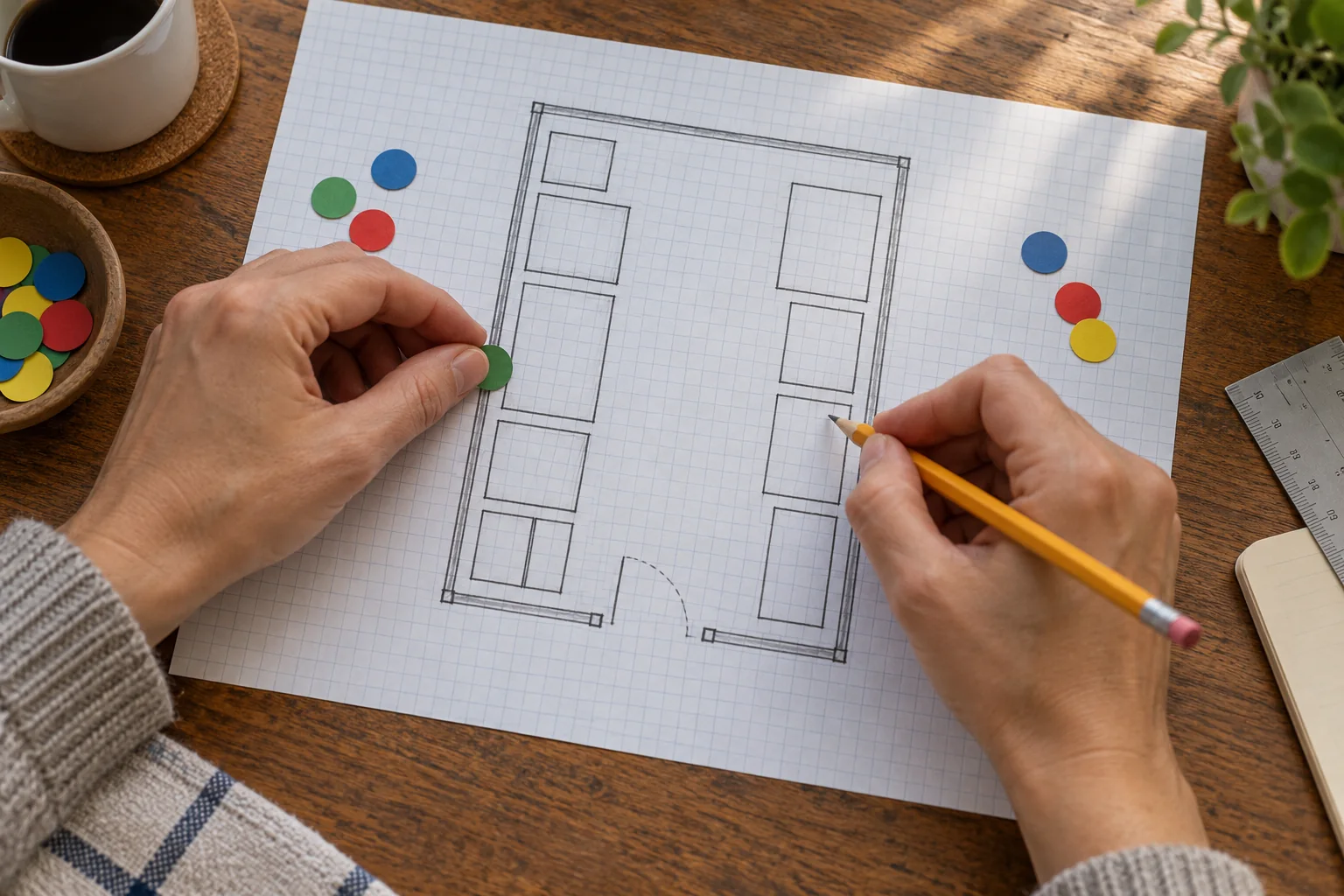
Draw a simple rectangle for the unit and mark the door. Put large, rarely needed pieces in locations that do not prevent access to likely retrieval items. Reserve an accessible zone for boxes you expect to open sooner. The plan does not need precise scale, but it should reflect real dimensions and the order in which goods will be loaded.
Think vertically as well as horizontally. A stack must remain stable and appropriate for the cartons below it. Heavy or strong containers generally need a suitable foundation, while fragile items should not carry a load they were not designed to support. Follow the facility's stacking guidance and the container ratings rather than relying on a photograph of an ideal-looking stack.
Leave a safe way to reach the planned access zone if the space allows. Do not promise yourself a walkway that disappears once the final chair is loaded. If the unit is too small for both the full load and access, decide which is more important and adjust the unit or the retrieval plan before moving day.
Number or name broad zones on the sketch, then record each box's final position. “S-14: front left” is better than “somewhere in storage.” Update the sketch after loading, because the real arrangement may differ from the initial plan. Keep the latest version with the inventory.
Load in retrieval order
The loading sequence determines what will be accessible. Items that will stay longest may enter first, while near-term retrieval boxes should be placed where they can be reached. This principle needs to be balanced with weight, shape, and stability. Do not create an unsafe stack just to put an early-use box near the door.
If a mover is loading, share the unit plan and identify the boxes that must remain accessible. Confirm whether the service includes placing items within the unit or only delivering them to the entrance. A vague instruction given after the truck is unloaded may be too late to change the order easily.
Check off each box and large item as it enters the unit. Compare the count with the transport list. If something is absent, find out whether it stayed at the old home, went to the new home, or remains on the vehicle. Reconcile while people and records are available, rather than months later.
Take final photos and update the location list before closing the unit. Photograph the door-facing arrangement and any accessible labels. Check the lock and access procedure under the facility's rules, then record who has the key or code. Do not store the only copy of the inventory inside the unit.
Keep storage and direct-move boxes separate
Use distinct temporary staging areas at the old home. A simple sign for “storage” and another for “new home” can prevent a box from following the wrong truck. Put the final destination on the box itself, because staging signs will not travel with it. Tell packers and movers how the two streams are identified.
The order in which you pack rooms also matters. Some storage-bound items may be packed early because they are rarely used, while everyday belongings need to stay available. Choosing a packing order when you still live in the home can help you preserve daily routines as packing progresses.
If the same box might be redirected at the last moment, do not leave two destinations visible. Update the label and the inventory before it is loaded. Record a changed delivery instruction with the responsible provider as needed. A box that reaches the wrong location may be hard to retrieve even when its contents are well documented.
Confirm counts at each handoff. The old-home list, transport record, storage inventory, and new-home list should agree on where each box went. They do not need to be elaborate databases; consistent codes and clear status marks are enough to make discrepancies visible.
Make a plan for retrieval and review
Set a reminder to review the unit and inventory if storage lasts longer than expected. Confirm that access credentials, contact information, and payment arrangements remain current. Check the facility's current procedures before a planned visit. The object is to keep the storage plan usable, not to create an unnecessary monthly ritual.
When you retrieve an item, mark the box or piece as removed and update its location or new destination. If you open a box and put part of its contents back, revise the private contents list. A carton labeled “winter linens” may no longer contain all of them after a visit.
Before moving everything out, use the inventory to decide whether each item still belongs in the new home. Some belongings may have remained unused because they were unnecessary; others were merely inaccessible. Make those decisions deliberately. Arrange transport and building access for large pieces with the same attention you used when storing them.
Inspect items when they come out and document any issue while details are available. Follow the facility's and transport provider's procedures where they apply. Reassemble furniture with the recorded hardware and instructions, then close out the inventory only when the goods are actually accounted for.
Storage works best when it is treated as a separate destination with its own access plan. Choose what belongs there, label and record it, pack for the item and facility, and load in an order that reflects future retrieval. That preparation turns a closed unit into a manageable extension of the move rather than an unidentified wall of boxes.